Once in a While
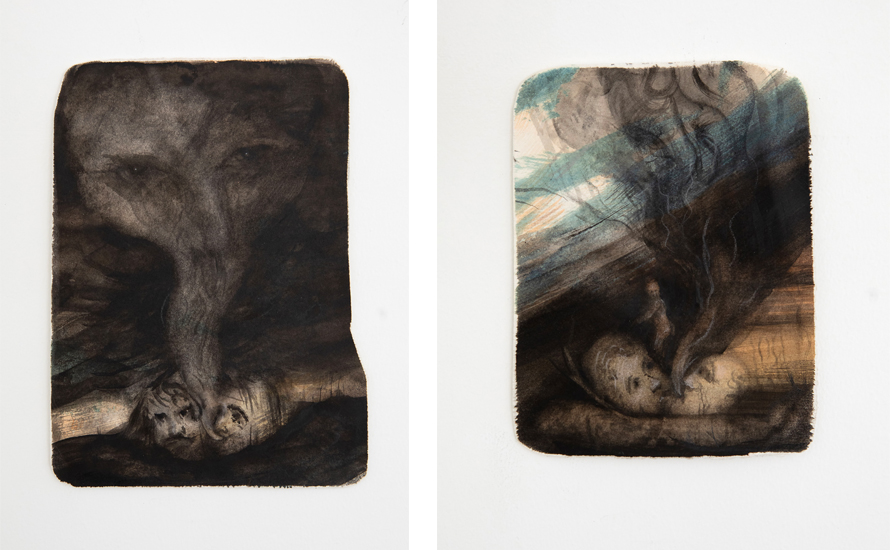
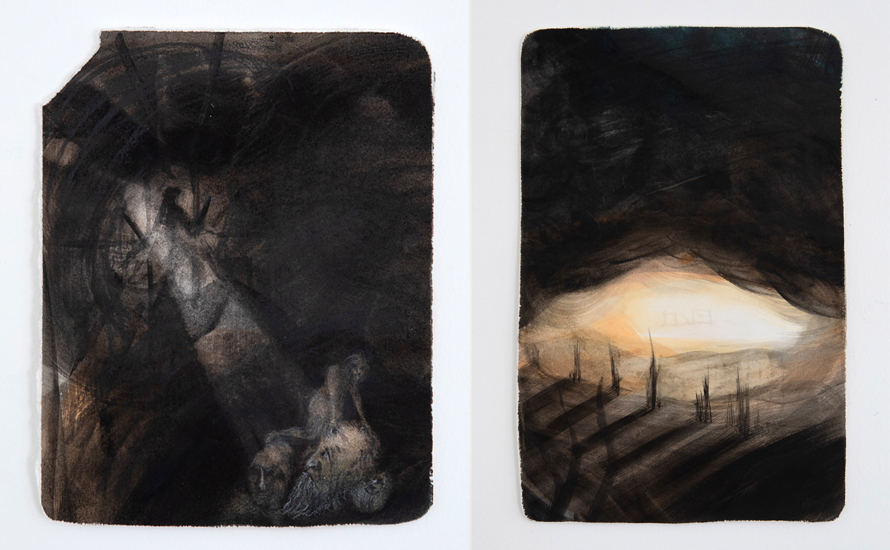
From mysterious caves, from the depths of black holes, from the world above to the world below, images and forms are born. Patches of darkness lie heavily on the paper, devouring sources of light: fire, a diagonal ray, shadows of lights breaking through windows and cracks. Like burial niches inhabited by the remnants of a living-dead civilization, the paintings reveal ruins of dust and ash. Seated on stones that have become fossilized heads, women are gazing at a beam of light, baring themselves, searching for a place to rest comfortably, or immortalizing their reflections on their mobile phones.
Images of stones appear in many of Avi Sabah’s works. For years, he would collect stones and draw them as a form of training for his hand and his drawing mind. Over time, these exercises became a daily ritual, forming a series of stone portraits, some bearing the names of women from his extended family. The bond between stones and names is inextricably linked to rituals of memory and burial. Yet, in Sabah’s expanded body of work, the stone is not merely present as evidence of death or as a fossil. Stones are also the source of fire, a timeless force of nature that, like an alchemical act, transcends cultures and traditions.
After several years of hunching over the studio floor (“Face Down,” “The Great Smoker,” “Tends to Be Forgotten”), Sabah now leans over the desk. The large sheets of paper are replaced by tiny, asymmetrical pieces with rounded corners. The large gestures give way to fine brushstrokes.
The series of paintings, “Once,” exists within an imagined space between origin and destruction, charged with silent violence. The watercolors seem to resist the transparency of the medium and are saturated with color, dense, and clouded. Occasionally, one painting is placed over another in a kind of temporary collage or archival documentation.
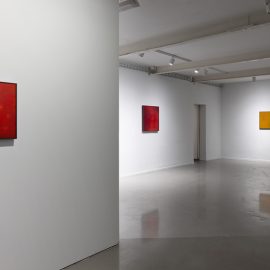
The eyes of the painting stare at you wide open, radiating. From a distance, the white gallery walls seem plagued with black lesions threatening to consume them. A closer look reveals the images on the miniature papers, like whispers shouted in a bustling place. The reduced scale does not diminish the sculptural power of the scenes, nor the spirituality shrouding these religious visions.
In one of the paintings, the word once stands mute within a rift of light. What exists only once in a while touches the eternity of once. Among stones that have tumbled face down and become heads lying on the ground, the word glimmers like a body that refuses to fade.