
The current exhibition is, admittedly, a graduation show of an academic track, but it is a display that exposes the work of only three artists, and by virtue of that constitutes an opportunity for a focused look at three solo shows. Although they differ from one another in essential ways, I would suggest that in all three there is a fascinating use of minor registers, an anti-declamation that encodes within it both subtleties and distinct modes of expression, and also subversive, question-raising potentials.
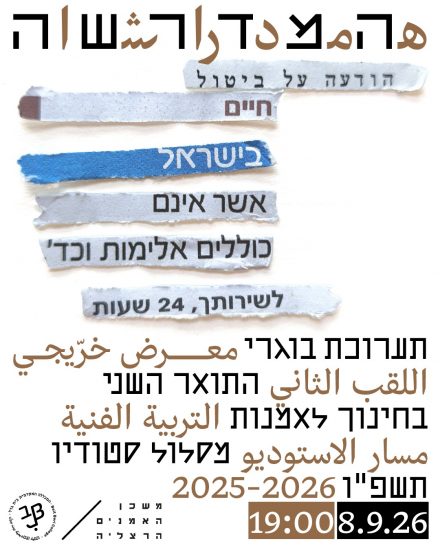
The core of Salma Samara-Shehadeh’s exhibition is the artist’s book “Breach of Order.” It is a book of poetry, except that it is written entirely by recomposing shredded letter fragments, the office-waste product of the artist’s home shredder. The words are thus gathered from letters that are the product of administration, bureaucracy and institutional correspondence. The poems are at once an embodiment of the spirit and language of the regime, and a whimsical departure from it. The fact that the language is the language of the place but not the mother tongue of the Jaffa-Palestinian artist ties the poet’s action to Deleuze and Guattari’s thinking on minor literature, and continues, in an unexpected direction, Dadaist and Surrealist chance traditions.
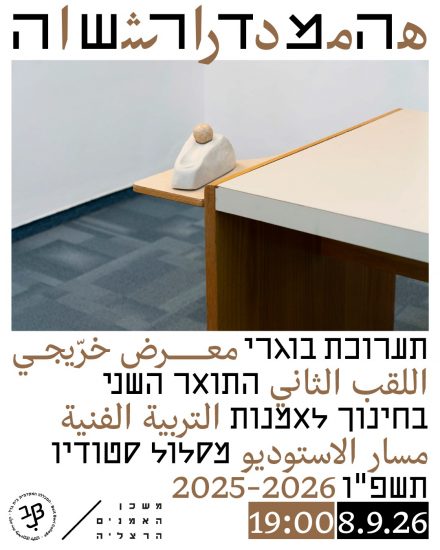
Yahav Gal’s exhibition activates what might be called “the secret of scribal magic.” The artist, whose previous specialization was photography, dives here into sculptural work rich in beauty and invention, in a manner that demands of itself a shift and a destabilizing of prior assumptions with every new piece. Different materials (porcelain, clay, artificial grass, readymade objects) are handled with gestures that carry equal measures of laconicism and one-time revelations. So, for instance, an office stapler is crossed with a porcelain sculpture of a rabbit, their bodies echoing one another, while at the same time a taut, animistic gap holds between the object-like and the living. The deceptive sensory register intensifies both through the delicate sculptural touch and through the simple, moving gesture of giving the rabbit a mustache made from hairs shed from the artist’s own cat’s whiskers. The works long to blend into and merge with a surrounding whose character is prosaic and gray, yet which sustains a kind of magic.
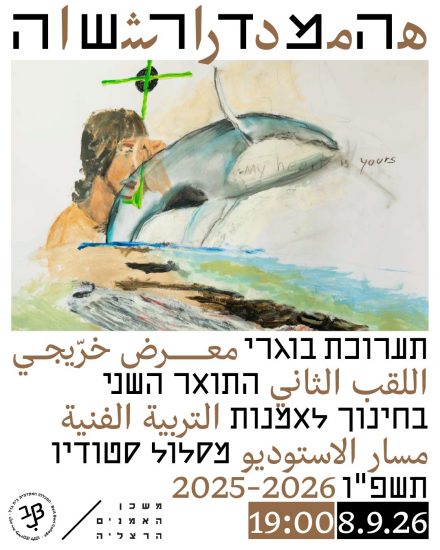
In the text accompanying her exhibition, Tamar Averbuch notes: “A person’s internal organs are not unique. All mammals have similar organs… when their period of being alive ends, they rot. What songs have we composed about them?” Averbuch’s distinctive painting is enlisted to mend this silence, and to formulate visual acts of poetry that refuse to acknowledge the boundary between the inside of the body and what lies outside it. Internal organs, objects, and animals are hybridized and fused as part of an eccentric, poetic and anarchic painterly syntax. A vacuum cleaner is enlisted into the action of a digestive system, a pair of lungs disguises itself as a pair of nuns. The act of painting remains always fast, the layers of paint sparse, and the movement from body to body frenetic.
The Studio track of the MA program at HaMidrasha is a distinctive framework that draws its sustenance from being an inseparable part of the Art and Film departments at HaMidrasha. It is a framework that places the artistic work itself at the center of a graduate degree in education, out of an understanding of the studio as a place where knowledge is not only acquired but generated through making, inquiry, conversation and critique. The track is led by the artist Shachar Yahalom, and it is undergoing an accelerated and exciting process of expansion. Heading the MA program is Dr. Vered Heruti.