
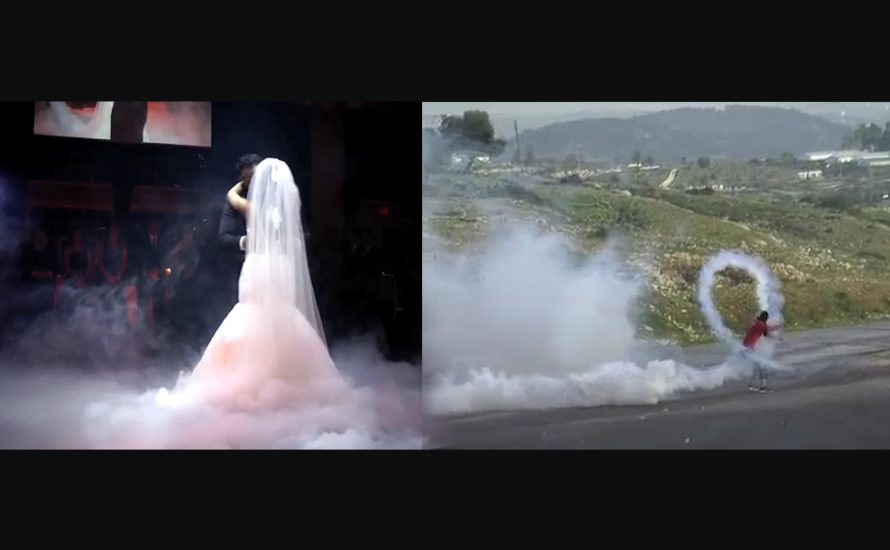

In the 3-part video work titled “Homewrecker”, Orr Menirom presents the story of a bride that has lost her memories and documentation of her wedding day, trying to retrieve them by watching viral videos on YouTube. She incorporates a variety of wedding video footage from the internet along with documentation of other public rituals, such as protests and various forms of civil resistance, as well as the aggressive measures used to suppress them. The resulting works raise questions regarding the true nature of wedding ceremonies – the day on which couples make their public declaration of their intention to preserve their relationship for the rest of their days.
Menirom is influenced by Sergei Eisenstein’s editing theories, using his techniques on the video clips she assembles. She removes the original soundtracks, revealing the mechanism of digital representation, and the impact of the language of new media on our formation of memories. Technology now allows anyone with access to a computer and basic editing software to blur the lines separating real and imagined.
Each of the three video works is fashioned to follow a different gestalt of viral videos. The first is set like a “bloopers” reel, an ongoing dance between footage of civil resistance and women hurt as they scramble to catch a bouquet. Tradition dictates the bride throw her bridal bouquet at the unmarried women in attendance, and the lucky girl to catch it will find her own groom within the year. The single women presented by Manirom are all overly enthusiastic as they fulfill their role in this social ritual, losing their balance as they make a grab, stumbling and then falling. The artist juxtaposes these images against footage of social protest, thus creating a third element – the choreography of a figure throwing a rock or canister of teargas transformed into the kitsch image of a bouquet hitting a gowned woman. A rock thrown in Israel may hit a bridesmaid in America, while at the bottom of the screen are subtitles with the lyrics of “Always On My Mind”, a song of remembering, though the work itself deals only with forgetting. At one point, the lyrics are interrupted, becoming a dialogue between the amnesia-ridden bride and her friend.
In the second part, structured like “dubbed” videos, the original track is replaced by a recorded track, and also subtitles.
The subtitles of the first part become even more significant here, as we witness the dialogue between a bride who cannot remember, and her friend. The dialogue is comprised of dozens of shots from the web, along with video clips Manirom inconspicuously took of pairs of women deep in conversation. The heroines of these intimate discussions are the women themselves. This personal and private dialogue is told on a mass scale – but this mass is not an unidentifiable mob, but the endless array of clear and distinct women.
The third part is based on animated stills images, presenting lost memories using the brides mobile phone.