
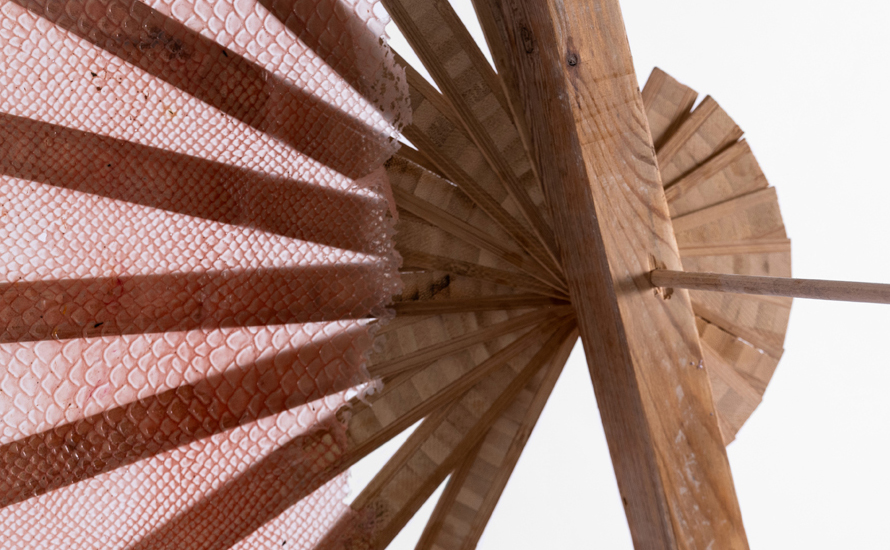
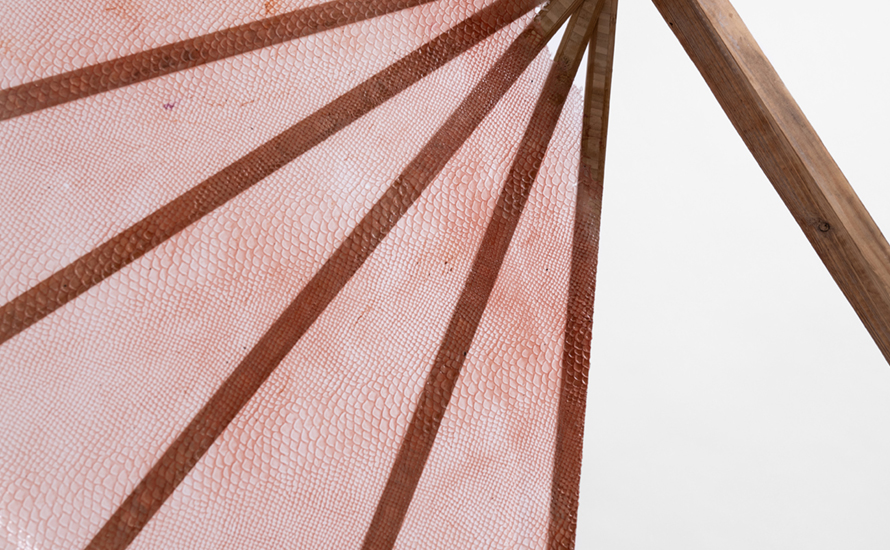
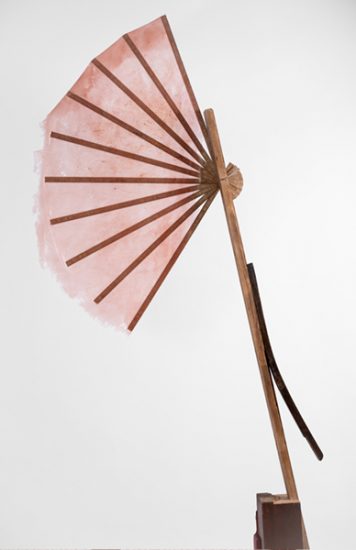
Shirel Horovitz’s sculptural space is inhabited by memory-laden structures reaching toward new forms. Her sculptural practice is grounded in calculated deconstruction and reconstruction, not in an attempt to conceal or erase the origins of the parts, but rather, to transform them into working materials. Old wooden doorframes and furniture parts collected from the streets are made into new wholes – fragile yet present with a quiet force. Still carrying traces of memory, cultural context, and previous uses, each part preserves, embodies, and echoes human life stories. While their fractures and scars of use are evident, so is the persistent vitality pulsating within them. Thus, the private and the collective are interwoven. What once belonged to the intimate domestic sphere was cast into the street, becoming part of the urban landscape. Later collected and transformed in the studio, it emerged as something new, an object in its own right, a sculpture that no one but Horovitz could have conceived. The result is human-scale sculptures that dwell in the space between stability and collapse. Part structure, part self-supporting being, they meet the viewers’ gaze and invite them to wonder whether sculptural forms can hold complex emotions.
The meticulous treatment of the layered wood – sanding, cutting, gluing, and polishing – produces a uniform texture that preserves the material’s presence. At the same time, compositions emerge that contain a contradiction between order and deconstruction, reflecting the complexity of human existence as a multiplicity that cannot be reduced to a single definition, and manifesting the persistent tension between the personal-private and the collective.
The slightly surrealistic quality of the works welcomes us into an open field of possible readings. They do not offer clear figures or representations, but rather abstract forms that blur categorical boundaries. Yet, though abstract, they assert a presence and a distinct identity. They seem to possess a point of view and a will of their own. In other words, Horovitz moves us from asking “what is this?” to “who is this?”
In Jewish tradition,* the word “zeh” (this) indicates what can be seen or touched but cannot be grasped theoretically or intellectually. The word “this” becomes a pointing finger – a presence outside itself – insisting on engagement with the real and the tangible. Similarly, in Daoism, pointing serves to indicate that a thing’s essence is inseparable from the thing itself. Definitions only create barriers between us and the things themselves: the gaze must pass from the pointing finger to what it points toward.**
With her work, Horovitz seeks to lead us to the material, visible, and experiential space of “this.” Yet, alongside their distinct material presence, the sculptures themselves exist in a liminal space of identity, materiality, and temporality, urging us to linger there beside them. Objects become creatures, structures become bodies. The definitions dissolve and destabilize, and the questions remain open. Are we looking at a sculpture? A temporary architectural structure? A giant insect? A fragment of a familiar landscape? We’re drawn into the tension between these possibilities, lingering in it alongside sculptures that bear accumulated memories as well as what is yet to come.
As in Daoism, Horovitz’s works challenge the distinction between the “serious” and the playful. The sculptures raise profound questions, generating an experience that undermines familiar perceptions of body and space, yet they are also charged with the playfulness of Lego blocks, relying on assembly methods drawn from the worlds of childlike imagination and joyful creativity. This playfulness isn’t merely aesthetic but essential. It allows the material to behave freely – to assemble, disassemble, and test the limits of stability – inviting us to complete forms and imagine possible structures. It also generates and seeks out subtle humor, enabling inquisitive observation and the discovery of new logic with each encounter. The material texture itself – the screw and nut joints, the changing palette, the positioning of the furniture legs – allows us to perceive and trace the sculptures’ internal logic and grasp the subtle relationships between them. Viewers are welcome to observe the works from different angles and explore the small details that compose the whole. The installation emphasizes the relationships between volumes, the interplay between form and weight, and the combination of natural and artificial materials. Thus, among the fragments and through the act of looking and lingering, which engages both body and mind, an intimate experience takes shape, one that invokes identification. After all, we, too, like the material, are recognizable and familiar, yet on the cusp of change.
Horovitz’s sculptural practice emerges from within the materials, exploring their relationships. The rationale driving the disassembly relies on the memory of the functional whole that once was. However, using these parts is not a gesture of repair but a search for a new form, one that respects their past while taking shape as a body in its own right. Thus, the material transforms from object to subject. The sculptures hold a wide range of emotions, memories, and desires.
In this context and beyond, Horovitz can be seen as part of a feminist sculptural movement that challenges demands for linear thought and fixed categories while proposing a new order.
The exhibition “This Which Is Not One”*** does not provide answers but opens a field of possibilities to ask, reflect, observe, and experience. It asks us to stay with the tension, to see fracture and unity as one, and to connect with the creative act of staying open to uncertainty.
______________
* Baruch Halevi Epstein, Torah Temimah – Deuteronomy, Vilna edition, 1904, Deuteronomy 21:20: “The word ‘zeh’ (this) connotes pointing with a finger, as it is stated in Menachot 29:1, Three matters, the Holy One, Blessed be He, showed Moses with His finger.”
**Jacob Raz, So I heard – Zen Lists, Modan, 2013.
***Luce Irigaray, Ce sexe qui n’en est pas un, Éditions de Minuit, 1977.
