Ophelia Underwater / Lilach Volach
The first cry is about the body itself. The baby throws her mouth open before she even opens her eyes. She is purple with effort, crimson with blood. A first breath and lo – a realization takes shape: she will soon be gone. She is only a body that came from a body, that came from a body that passed through a body. The lament of being born, that’s what this cry is (I was told later, underwater).
Eventually, I was born in a body. Not simply a body: a female body. That’s the hardest. Before I became me, when we were still the wholeness, we contemplated a raspberry bush and various small birds. At one point, even a pebble – blemished but full of character – was considered. But eventually, I was born in the body of Eve. How peculiar and fleeting. Of all things, a body! With its flaking skin, its chalky fingernails, its spongy, repellent moles, its shedding hair. An animal, yet not quite an animal; an animal that believes itself to be a non-animal. Those are the worst.
We even considered a shoal of herring. Fragments of consciousness, soul, or whatever you call it these days, spread among the shimmering fish moving in unison. They move as one because they are particles of a whole, I was told underwater, and I immediately understood everything because I already recognized everything. My body is already caught in a thicket of water lily roots, who conceal it from the flowers, because they are too delicate to know. No beauty is without ignorance.
The underwater is nymph-green, a green smoldering with blue undercurrents, like cypress needles. The underwater has the blue-green scent of detergent for ceramic toilet bowls that won’t be invented for another 250 years. The underwater is beyond time and space. I know how to know everything. Parts of my body disintegrate. Newts, daphnia, and leeches feed on the pampered flesh I used to be. Eels eel among the remains of my ribs. The body, as a body, holds memories, and they, too, will be absorbed by the water, diluted until they disperse. But in the meantime, I remember torn skin, a purpling bruise, a broken bone, a gaping wound. I remember pus and spit, feces and urine. I remember blood. I remember wetness. I remember semen.
One time, when I was a body, fantastic garlands I did weave, of crow-flowers, nettles, daisies, and long purples that liberal shepherds give a grosser name, but not I. Not I. I’m a chaste maid; a dead maid. And like all chaste, dead maids, I call them Dead Men’s Fingers, clenching my jaw so no scream escapes. I will not name them Dog’s Stones, I dare not. Not I. I do not say stones, balls, cunt, cock. Not with the mouth that kissed my mother, not with the mouth that kisses the back of my hand, practicing for the day he would kiss me, and not just rub himself resentfully against my arse as if I forced him to do something against his will; as though I coaxed it out of him by deceit. Translucent eels rub themselves against my pelvis and hip bones, tearing away pale, bloodless tissue that drifts in the water like torn curtains. I remember blood I remember semen. This memory too will thin out and dilute in the water.
They called me a baby and a poisoned bud, unsifted in such perilous circumstances. The muddy death wasn’t that bad, really. It was a heavy blanket, an embrace I wasn’t required to refuse. It wasn’t the muddy death that posed the danger. They bore her barefaced on the bier and cast flowers upon her. Bullshit. What use are flowers now. Look what you’ve done. Have the courage to see what you’ve done. At least I’m not condemned to see the flesh wither, to part in slow funeral cortege from rounded breasts and supple buttocks, to watch as cheeks hollow and teeth fall from shriveling gums. The problem wasn’t with my body, but with my head. That’s what they thought. As if the head were not part of the body. I didn’t go mad; you drove me fucking crazy. Maybe next time I’ll be born a pineapple. I could do with a little exotica.
I know how to know everything here. I met Lizzy underwater. She became very ill because of me, but even more because of them. For months, she lay in a bath of cold water so that he could paint her red hair floating. Such a beautiful work, what can I say, to die for. I don’t have red hair and never did; he shouldn’t have bothered. She got sick from the cold water, and later from the poppies they fed her; she bore a blue stillborn daughter. And then she herself died. You see where this is going. A body that came from a body, that came from a body that passed through a body, a long chain of women strung on an iron wire. I know how to know everything here, all the stories, the sweet lies and the bitter lies. I float between what you consider sublime and down to the sewers you keep hidden from yourself. I know that only people suffer, and not because other things do not feel pain. Self-pity is also uniquely human.
The owl was a baker’s daughter. Better an owl than a daughter. Better an owl than a mother, a sister, a wife, a whore.
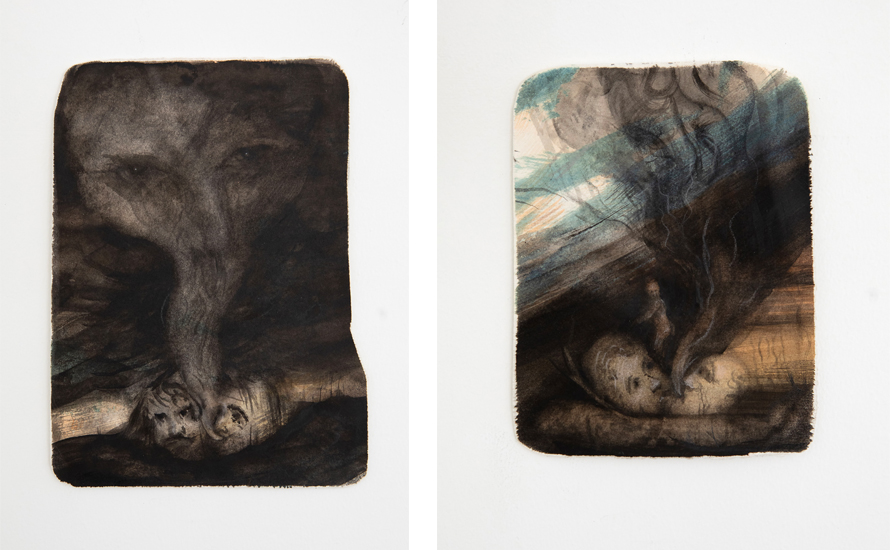
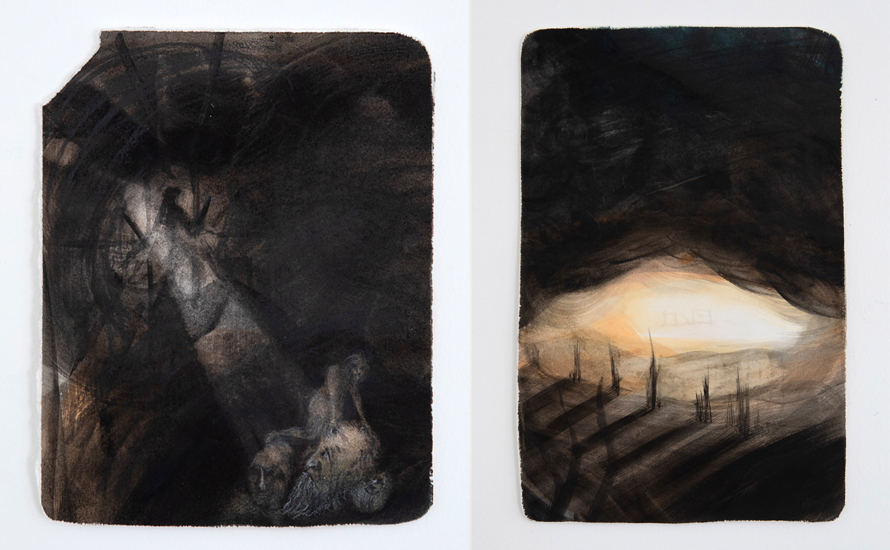
“Ophelia Underwater” is a group exhibition of the “wrong” female body—the one that defies by its very existence, that asserts itself at too high a volume, with an unapologetic presence.
The figure of Ophelia from “Hamlet” serves as the exhibition’s point of departure. But this is not the pure and innocent maiden silenced by her father, brother, and lover. This is an Ophelia who finds her voice in madness, whose insanity breathes into her a vitality that was stolen from her in her sane life.
The works in the exhibition present bodies that live beneath the waters of the radical mainstream. These are the excessive, the vulgar, the despised—whose physical existence is a defiance of the existing order. Not necessarily from a desire to defy, but from a refusal to shrink, to be silent, to ask permission to exist.
The Ophelias in this exhibition are not beautiful in their death, nor quiet in their drowning. They remain under water, continuing to speak and take up space.


